Contents12 sections
- What is Military Unit 41772
- Seven to Eight Months to Create – And Immediately Into Battle
- Vovchansk: The First Battle Became Permanent
- Kursk Oblast and Return to the Kharkiv Direction
- First Commander: Alexander Pobokov, Call Sign "Bars"
- 98 Days of "Astrakhan"
- "Sochi": Vladislav Nikiforov and an Internal Complaint
- About a Thousand in Three Months: How to Read This Figure
- July: 6th Company and Desertion from the Unit
- Why the Change of Commanders Did Not Solve the Problem
- What Is Proven and What Remains an Assertion
- Conclusion: A New Brigade That Is Already Being Reassembled
The 128th Separate Motorized Rifle Brigade has existed for just over two years. During this time, it was formed from new contract soldiers, committed to battle near Vovchansk, redeployed to Kursk Oblast, returned to northern Kharkiv Oblast, and had its command changed several times. In June 2026, the Russian "Severny Kanal," which publishes appeals from servicemen of the "Sever" (North) Group of Forces, stated that over the previous three months, the brigade had lost about a thousand personnel killed, wounded, and missing in action, and its battalions were being re-manned.
One thousand is not a confirmed number of named casualties. The source combined three categories, and the editorial board does not have a complete list. However, the text of the appeal itself, individual publications about missing personnel, complaints about medical decisions, and reports of the de facto reassembly of battalions indicate a crisis that cannot be explained by a single unsuccessful company.
The crisis has names. Colonel Alexander Pobokov commanded the brigade during its formation and initial battles. On October 27, 2025, he was replaced by Alexander Mikhailov, call sign "Astrakhan." After 98 days, Mikhailov was removed. Since February 2026, Colonel Vladislav Nikiforov, call sign "Sochi," has been named the acting commander. Three commanders in less than two years is not automatic proof of failure for each, but it is a clear indicator of command instability.
What is Military Unit 41772
The 128th Separate Motorized Rifle Brigade is part of the 44th Army Corps of the Leningrad Military District. Its confirmed number is Military Unit 41772. The number 24345 appears in open databases, but it does not withstand verification. An official protocol from the Usolye-Sibirskoye charitable foundation dated November 18, 2024, directly records an appeal from "Commander of Military Unit 41772 Colonel Pobokov A." requesting the purchase of a thermal imaging sight and mount for a soldier.
This document is important for two reasons. It links the unit number to the name of the first commander and the date when the brigade was already fighting. Simultaneously, it shows the material side of the new military unit: even a thermal imager and mount were requested through a regional charitable foundation, rather than being provided centrally.
The 44th Corps was created after the restoration of the Leningrad Military District. Its main maneuver formations became the 72nd Motorized Rifle Division and the 128th Brigade. On paper, this is a reinforcement of Russia's northwestern direction. In practice, the new formation was almost immediately used not near Finland, but in the war against Ukraine.
Seven to Eight Months to Create – And Immediately Into Battle
The Estonian Foreign Intelligence Service described the formation of the 44th Corps as a process that took seven to eight months between autumn 2023 and spring 2024. The basis was newly recruited contract soldiers. Training, according to the agency's assessment, was brief and focused on individual skills and actions at the squad, platoon, and company levels.
In May 2024, the 72nd Division and the 128th Brigade had already entered their first battle in Kharkiv Oblast. Thus, there was almost no time left for full coordination of the brigade, its artillery, communications, reconnaissance, logistics, and medical support. The formation learned to exist simultaneously with the offensive.
On May 12, ISW noted elements of the probably reconstituted 128th Brigade as part of the northern grouping. The Russian operation aimed to create a "buffer zone" and stretch Ukrainian reserves. The initial advance quickly slowed down in Vovchansk and its approaches. For the new brigade, the short training period ended in urban combat.
Vovchansk: The First Battle Became Permanent
Vovchansk is only a few kilometers from the Russian border. In May 2024, Russian units entered the northern part of the city but could not quickly establish full control. The Vovcha River, destroyed blocks, industrial facilities, and constant drone activity turned the area into a protracted positional meat grinder.
In August 2024, ISW recorded the 128th Brigade in the Vovchansk district. At the same time, up to three of its battalions might have been redeployed to Kursk Oblast after the Ukrainian breakthrough. This means that the newly formed unit was first used in an offensive and then partially stretched between two crisis areas.
The redeployment does not mean that the entire brigade simultaneously left Vovchansk. Open reports speak of elements and battalions, not the full complement. But for coordination, this is critical: units with short general training were separated, subordinated to different operational tasks, and then reassembled in the same direction.
Kursk Oblast and Return to the Kharkiv Direction
After the start of the Ukrainian operation in Kursk Oblast, the Russian command gathered reserves from various sectors of the front. ISW, citing military observer Konstantin Mashovets, reported the redeployment of parts of the 128th Brigade and the 72nd Division. Battalions might have been below their authorized strength already at the time of movement.
In 2025, the brigade was again recorded in the Kharkiv direction, and individual elements appeared near the northwestern border of Belgorod Oblast. Such geography creates the appearance of versatility: the new formation closes any emerging gap. But this versatility comes at a price – the absence of a long recovery period and constantly changing subordination.
Russian official and pro-war press reported on destroyed drones and the advance of assault groups. Such publications confirm the presence of the 128th Brigade but almost never mention their own losses, mission failures, or timelines for unit reassembly.
First Commander: Alexander Pobokov, Call Sign "Bars"
Colonel Alexander Pobokov is the only one of the three commanders whose connection to the number 41772 is confirmed by an official document. The charitable foundation's protocol records him as the unit commander in November 2024. Russian military sources refer to Pobokov as "Bars" and link him to the brigade's command from its formation until October 2025.
It was under Pobokov that the brigade went through the first Vovchansk and the Kursk redeployment. In the collective appeal of June 2026, the authors wrote that after "Bars" left, the situation sharply deteriorated. This is a subjective assessment by subordinates and not an exoneration of the previous commander: heavy fighting and losses began long before his replacement.
According to "Severny Kanal," Pobokov was transferred to the reserve after his removal. There is no public order explaining the reason for the personnel decision. The system only left the consequence – a new commander and a new phase of the crisis.
98 Days of "Astrakhan"
On October 27, 2025, Alexander Mikhailov, call sign "Astrakhan," previously associated with the 1427th Motorized Rifle Regiment, took command. On February 2, 2026, "Severny Kanal" reported his removal – after 98 days. The channel claimed that by this point, the brigade had practically lost its combat capability and needed restoration.
This assertion has no published inspection report. It cannot be presented as an official assessment by the General Staff. However, such a short command period and the subsequent reassembly of battalions are consistent with the version of problems. If Mikhailov was removed due to the state of the formation, the question arises as to what tasks he received and how worn out the brigade was when he took command.
A personnel change in itself does not restore companies. The new brigade commander receives the same lists of missing, wounded, those who refused to fight (SOCH), and equipment requiring repair. Therefore, 98 days is not only a characteristic of Mikhailov. It is an indicator of how quickly the staff expected results from a formation created less than two years ago.
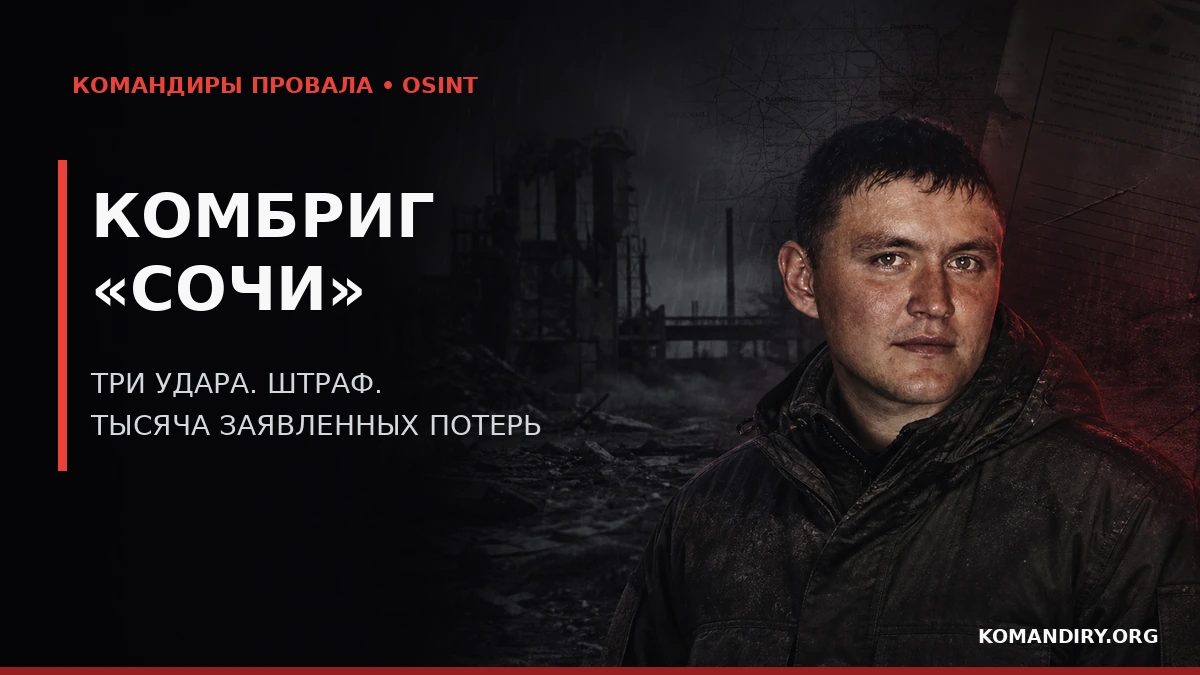
"Sochi": Vladislav Nikiforov and an Internal Complaint
On February 17, "Severny Kanal" introduced the new acting commander – Colonel Vladislav Nikiforov, call sign "Sochi." He previously commanded the 7th Motorized Rifle Regiment. The editorial board did not find an open order from the Ministry of Defense, so the position is confirmed by military sources, not an official personnel announcement.
On June 20, the same channel published a collective text on behalf of officers, sergeants, and privates of the 128th Brigade. The authors accused the command of non-payment of money, delayed awards, lack of contact with units, and sending people on poorly prepared tasks. They linked mass cases of SOCH (refusal to fight) to the behavior of commanders and promised a complaint to the prosecutor's office.
The appeal specifically criticized the medical service: the authors claimed that genuinely sick and wounded personnel were being declared fit for combat. Along the reconnaissance line, there were accusations of monetary extortion and group losses. These statements are anonymous and contain emotional assessments. They cannot be attributed to specific individuals without verification, but the very fact of a joint appeal from within the unit cannot be ignored either.
About a Thousand in Three Months: How to Read This Figure
Before publishing the letter, "Severny Kanal" reported its own estimate: about a thousand losses in the last three months – killed, wounded, and missing in action. The channel then wrote that battalions were being re-manned and sent back to the combat zone.
This figure does not mean a thousand killed. It includes the wounded, some of whom may have returned to duty, and the missing, whose status changes after a search. There is no list of names, distribution by category, or methodology for calculation. Therefore, it cannot be combined with individual obituaries or declared as an exact total.
At the same time, the word "about" does not make the message meaningless. For a brigade with an authorized strength of several thousand personnel, even a thousand cumulative losses in a quarter means the loss of a significant proportion of people. The declared reassembly of battalions is an organizational sign of the same attrition.
July: 6th Company and Desertion from the Unit
On July 6, the channel reported twelve confirmed deaths in one day and claimed that most of the 6th Company had been wiped out in a week. The same publication mentioned at least four cases of SOCH (refusal to fight) per day. The editorial board could not independently confirm all numbers by name.
However, individual search publications regularly mention Military Unit 41772. Relatives were searching for servicemen who went missing in the Vovchansk area and neighboring settlements in 2025–2026. Such records confirm the geography and a steady stream of missing personnel but do not allow for a full reconstruction of the brigade's balance.
Another mother reported that her son was not being discharged or sent to a military medical commission (VVK), despite having a "V" category (limited fitness for service). This echoes the collective complaint about the medical service. As in the case of the 126th Regiment, a wounded or partially fit person remains a resource for the unit until documents force the command to remove him from the lists.
Why the Change of Commanders Did Not Solve the Problem
Pobokov built the brigade and led it into battle. Mikhailov lasted 98 days. Nikiforov received a formation that, according to internal sources, already needed restoration. At each stage, the commander could change executors and methods, but not the initial conditions: brief training, constant redeployments, and the requirement to continue the offensive.
This does not absolve commanders of responsibility for specific orders. On the contrary, names are needed precisely for verification: who determined tasks for companies, who signed medical decisions, who reported on combat capability, and who received information about the missing. But explaining the entire crisis by the character of one "bad brigade commander" is too convenient for higher command.
The 44th Army Corps was created as a symbol of army expansion. The 128th Brigade shows the flip side of expansion: a staff can be formed in months, but an experienced collective cannot. When Vovchansk follows instead of training, and Kursk and a new deployment follow instead of restoration, personnel reshuffles turn into a change of names over the same incomplete battalions.
What Is Proven and What Remains an Assertion
Documentarily confirmed are Military Unit 41772, its affiliation with the 44th Corps, the name of Commander Pobokov, and the unit's participation in battles since May 2024. Estonian intelligence and ISW independently confirm the short formation cycle, the Vovchansk direction, and the redeployment of brigade elements to Kursk Oblast.
Publications by "Severny Kanal" confirm the existence of complaints, dates of command changes, and the wording of the claimants. But about a thousand losses, the state of the 6th Company, extortion, specific illegal orders, and medical violations require verification through unit logs, medical documents, and named lists.
The editorial board did not find a public response from Nikiforov, Mikhailov, or the command of the 44th Corps to the collective appeal. Nor is there an open verdict establishing their personal guilt. Therefore, the material speaks of command responsibility as a subject of investigation, not a legally proven crime.
Conclusion: A New Brigade That Is Already Being Reassembled
The 128th Separate Motorized Rifle Brigade was supposed to demonstrate that Russia could quickly expand its army. It indeed appeared in a few months. But its very first deployment showed the difference between creating a unit number and creating a combat-ready formation. Contract soldiers with short training were sent to Vovchansk, then part of the forces were redeployed to cover Kursk Oblast, after which the brigade continued to operate near the border.
Less than two years later, a Russian military source writes about a thousand cumulative losses in a quarter and the reassembly of battalions. During the same time, three commanders changed. Official reports continue to count destroyed enemy drones and occupied ruins but do not explain to their own servicemen who is responsible for the vanished companies, treatment, and payments.
The main failure of the 128th Brigade is not a single unsuccessful attack. It is an assembly line: quickly recruit, quickly deploy, divide between directions, change the brigade commander, and re-man again. Military Unit 41772 retained its number. The people within that number have to be recruited anew.